

CAA Receives Head of the Government Communication and Performance Development Unit to Review Its Work System
- The visit aims to share the Authority’s experience in managing its institutional, operational and communication systems.
- H.E. Dr. Yousuf Al Hinai, Head of the Unit, praised the Civil Aviation Authority’s experience in institutional and media communication.
- The visit coincided with the Authority’s documentation of its communication practices in a dedicated publication covering 16 key areas.
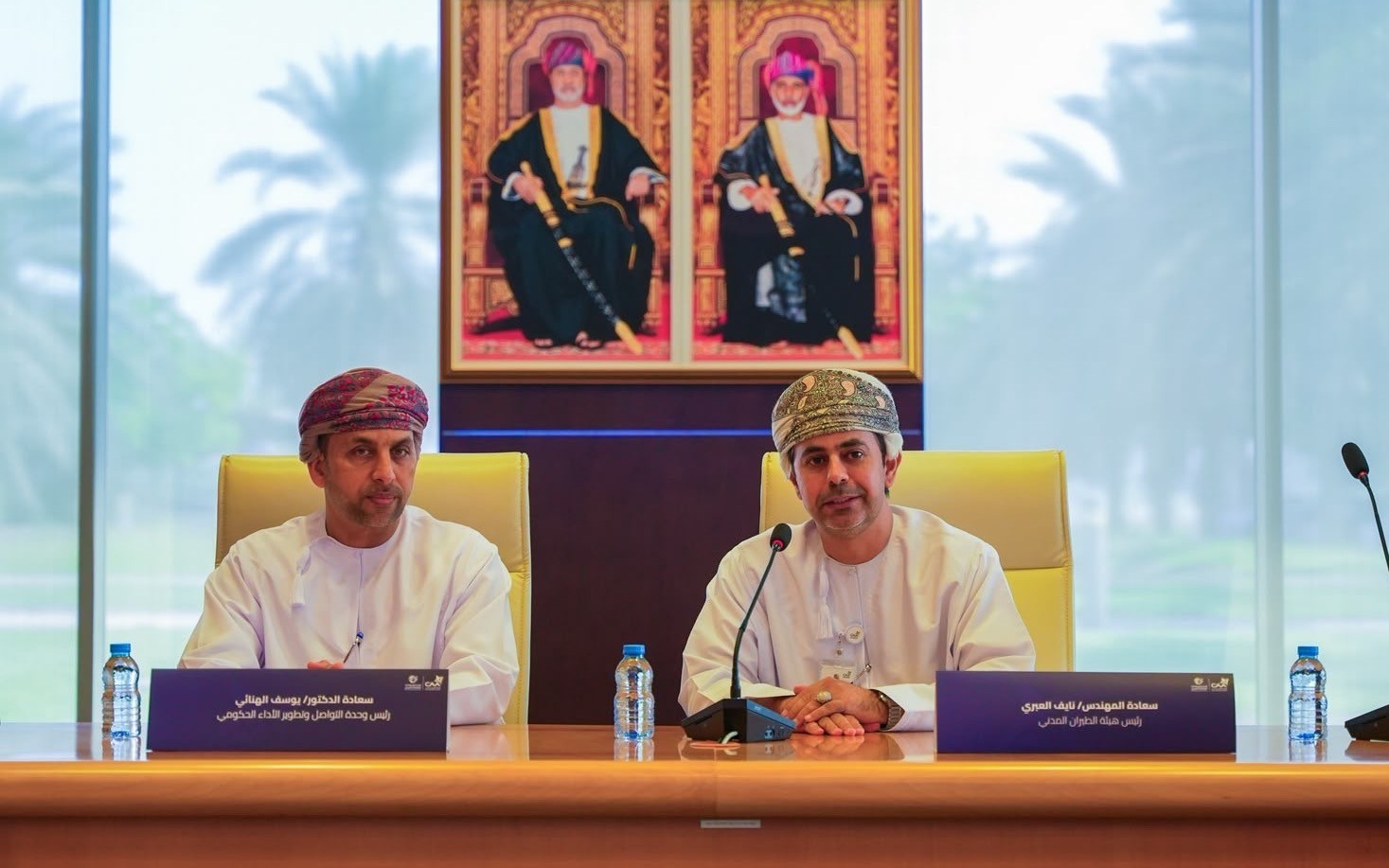
The Civil Aviation Authority (CAA) received H.E. Dr. Yousuf bin Salem Al Hinai, Head of the Government Communication and Performance Development Unit at the General Secretariat of the Council of Ministers, on an official visit aimed at reviewing the Authority’s experience in managing its institutional, operational and communication systems, and learning about its key practices in performance development and strengthening communication with various segments of society.
The visit came within the framework of supporting institutional integration and exchanging expertise and experiences among the administrative units of the State. The delegation included a number of officials and directors general from the Unit.
During the visit, the delegation was briefed on the Authority’s mandates and its regulatory and operational roles, as well as its efforts to develop the civil aviation system and enhance safety and efficiency levels.
The delegation also learned about the mechanisms for managing information and institutional communication in a sector directly linked to public safety and the continuity of essential aviation services.
The visit also included the National Early Warning Centre for Multiple Hazards, where the delegation was introduced to its monitoring and surveillance system, mechanisms for dealing with weather conditions and potential hazards, and the procedures followed in issuing alerts and warnings and delivering information and awareness materials to relevant entities and the public.
These efforts contribute to strengthening national preparedness and supporting the risk management system.
The delegation further visited the Muscat Air Traffic Control Centre to learn about air traffic management, aircraft monitoring and the regulation of traffic flow within the airspace, as well as the role played by national personnel and operational technologies in ensuring the safety and efficiency of air navigation operations in accordance with approved international standards.
The visit also included the Civil Aviation Authority’s Media Centre, which presented the achievements of the Authority’s media and communication system, including mechanisms for preparing content, managing media coverage and handling major and emergency events within a well-structured and carefully planned timeframe.
The Centre also highlighted the use of digital platforms and communication channels to deliver information and raise public awareness of the Authority’s mandates and services, the components of the aviation sector and the roles performed by its various entities.
H.E. Dr. Al Hinai praised the Civil Aviation Authority’s experience in institutional and media communication, highlighting the integration between the technical and operational nature of its mandates and the requirements of government communication.
He emphasized the importance of benefiting from the communication practices adopted by the Authority and the need to exchange and disseminate them in support of developing the government communication system across the Sultanate of Oman.
The visit coincided with the Civil Aviation Authority’s issuance of a dedicated booklet documenting its communication and media practices. The publication showcases the Authority’s experience in developing an institutional communication system based on governance, strategic planning and the integration of media messages, thereby enhancing communication efficiency with the public and supporting the Sultanate of Oman’s regional and international presence in the civil aviation sector.
The booklet documents, across 16 key areas, the practices, policies and procedures adopted by the Authority to regulate communication and media activities, manage digital platforms and strengthen partnerships with media institutions. It also addresses crisis and rumor management, preparing the public for decisions related to the Authority’s mandates, as well as public awareness initiatives and tools across its areas of operation.
Institutional communication is a strategic enabler for enhancing the efficiency of government institutions and achieving their objectives through the establishment of an integrated communication and media system founded on governance, strategic planning, proactiveness and integration, while keeping pace with the rapid transformations in the media and communication environment.
The integration of communication practices, beginning with clear policies and defined responsibilities, followed by content production, communication channel management and the strengthening of media relations, and extending to measuring engagement, anticipating developments and responding to them, helps establish a more mature and flexible institutional media approach. This, in turn, enhances the Authority’s ability to keep pace with the requirements of the civil aviation sector and its rapid developments.
In the area of media governance, the Authority adopted its Media Policy under Administrative Decision No. (1553/2023) to regulate media activities, unify messages, define the authorities responsible for issuing statements and publishing information, and establish mechanisms for handling media requests.
This was complemented by the development of guidelines and procedures governing internal and external publications, event management and media coverage, as well as the application of the institutional identity in both Arabic and English.
The publication also highlights the importance of communication integration among sector institutions through coordination with Oman Airports, Oman Air, SalamAir, Al Sharqiya Aviation, Oman Aviation Academy and start-up companies.
This includes implementing joint awareness campaigns and events, exchanging information and unifying media coverage, thereby ensuring consistency in messaging and highlighting the complementary roles of the institutions concerned.
It also sheds light on the use of media and digital monitoring to follow issues circulating across various platforms, verify information before responding to it and provide clarifications through official channels. In addition, the Authority has adopted a methodology for media engagement during crises, encompassing advance preparedness, information verification during the crisis, performance evaluation and documentation of lessons learned afterwards.
These practices are supported by awareness initiatives, including “A Question in Aviation”, which aims to simplify information related to the sector and correct misconceptions.
In terms of digital transformation, the Authority adopts well-defined and carefully planned mechanisms for organizingcontent according to the nature of each platform and its audience, protecting official accounts and improving the user experience on its websites, while conducting periodic studies to measure performance and monitor audience trends.
The CAA has also developed internal communication channels and a package of awareness programs to strengthen engagement among the various components and specializations of the aviation sector and reinforce institutional culture.
This communication approach also extends to involving the community in service development through public consultations and opinion polls, which have covered the Passenger Rights Protection Regulation, services provided at Muscat International Airport and Salalah Airport, and digital platforms related to unmanned aircraft.
It also includes expanding communication with young people and persons with disabilities, as well as producing multilingual content targeting audiences both within and outside the Sultanate of Oman.
The booklet emphasizes that developing institutional communication is an ongoing process linked to enhancing performance efficiency, strengthening transparency and trust, and reinforcing the role of media as a strategic partner in supporting the objectives of the civil aviation sector. This approach keeps pace with national priorities and strengthens the Sultanate of Oman’s presence at regional and international forums.