


The Sultanate of Oman Joins the Global Celebration of World Meteorological Day
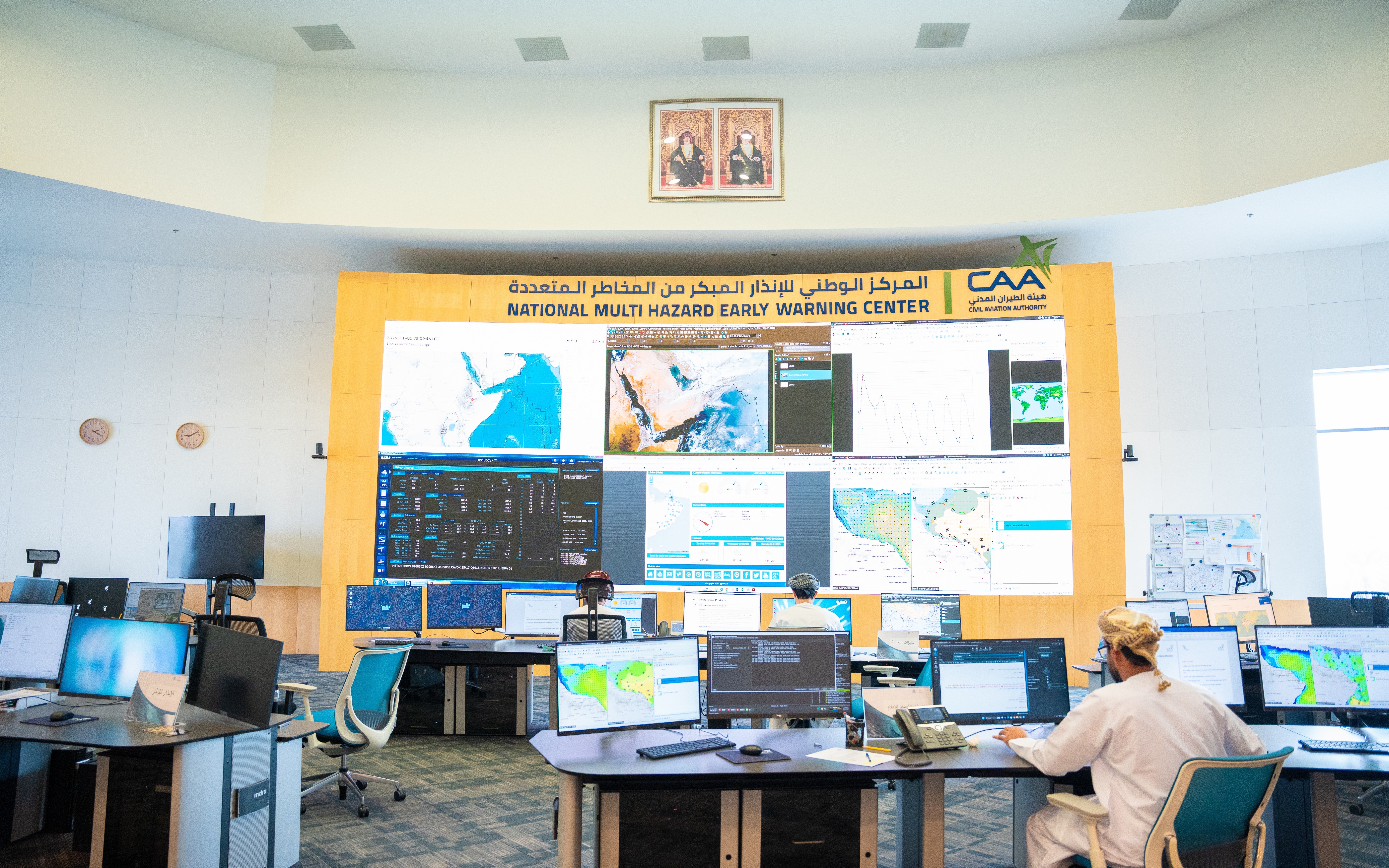
The Sultanate of Oman, represented by the National MultiHazard Early Warning Center of the Civil Aviation Authority, joins countries around the world in celebrating the World Meteorological Day, which is observed annually on March 23, commemorating the entry into force of the Convention of the World Meteorological Organization in 1950.
This year’s 2026 observance is held under the theme “Observing Today, Protecting Tomorrow,” highlighting the importance of atmospheric and hydrological monitoring in supporting weather forecasts and early warnings, as well as the role of youth and communities in building resilience to natural hazards. Across the globe, individuals and institutions contribute daily to observing the Earth, from monitoring weather and water to enhancing climate awareness and advancing early warning systems.
On this occasion, Professor Celeste Saulo, Secretary General of the World Meteorological Organization, stated that the efforts of meteorologists, researchers, and engineers worldwide form an integrated system that enhances understanding of weather and climate with greater precision, enabling forecasts and early warnings that help protect lives and support sustainable development. She emphasized that observing today is the first step toward protecting tomorrow.
She added that monitoring weather conditions is not limited to forecasting alone, but represents an investment in safeguarding the future. Weather predictions rely on millions of daily observations collected through a global network coordinated by the World Meteorological Organization, supporting critical decision-making in aviation, energy, agriculture, and risk management, in addition to issuing early warnings that save lives and protect communities worldwide.
At the national level, the Sultanate of Oman continues to advance meteorological services through an integrated system of observation, forecasting, and early warning, reinforcing its role as a key pillar in supporting public safety and sustainable development.
In 2025, meteorological services recorded indicators reflecting integrated roles in supporting community safety and the aviation sector. The number of weather monitoring stations reached 83 stations distributed across all governorates of Oman, in addition to issuing 2,850 special weather bulletins, 10,950 aerodrome forecasts (TAF), and 1,460 aviation weather charts, along with 82 warnings for Omani airspace and 423 runway-specific warnings.
These indicators reflect the vital role played by the meteorological system in supporting key sectors, particularly civil aviation, by providing accurate and continuous data that enhances aviation safety levels and raises the readiness of airports and air navigation service providers. The importance of this data also extends to other sectors such as water resource management, energy, national infrastructure projects, urban planning, and natural disaster risk management.
As part of strengthening the early warning system, the National Multi Hazard Early Warning Center was established in 2004 and officially inaugurated in 2015, becoming one of the first specialized centers in the region to provide integrated alerts and warnings for natural hazards such as tropical cyclones, severe weather events, flash floods, and tsunami risks resulting from undersea earthquakes.
The center operates around the clock to monitor weather conditions and natural hazards and to issue alerts and warnings through various communication channels, including the Oman Meteorology website, SMS messages, different media outlets, Smartphone applications, and social media platforms, ensuring the timely delivery of accurate information to all segments of society.
The center relies on an advanced system of technologies, including networks of meteorological stations, weather radars, satellite data, and sophisticated numerical models that contribute to analyzing and forecasting weather phenomena with high accuracy. In recent years, this system has witnessed significant development under the strategic “Muzn” program launched by the Civil Aviation Authority to enhance meteorological and early warning systems during the period 2023–2026. Several strategic projects have been implemented, including upgrading observation station networks, strengthening weather radar capabilities, developing numerical forecasting systems and databases, and establishing advanced digital platforms for delivering meteorological information.
In this context, Abdullah bin Rashid Al Khudouri, Director General of Meteorology at the Civil Aviation Authority, noted that these efforts come within a strategic vision aimed at improving the accuracy of weather forecasts and enhancing the efficiency of early warnings, thereby supporting community safety and the aviation sector while contributing to national development plans.
The development also includes the use of modern technologies such as artificial intelligence and big data analytics to support weather forecasting processes and analyze complex atmospheric phenomena, as well as enhancing system capabilities to track tropical cyclones in the Arabian Sea and forecast heavy rainfall and flash floods.
At the level of international cooperation, the Sultanate of Oman is keen to strengthen its partnerships with international and regional organizations, foremost among them the World Meteorological Organization (WMO), through participation in scientific and training programs and the exchange of data and expertise with global forecasting centers. This contributes to improving the accuracy of weather predictions and enhancing the capacity to address severe weather phenomena.
The Sultanate of Oman, represented by the Civil Aviation Authority, also hosts the Center of Excellence for Satellite Applications in Muscat, operating under the supervision of the World Meteorological Organization and the European Organization for the Exploitation of Meteorological Satellites (EUMETSAT). It serves as a specialized regional platform for capacity building and training programs in the use of satellite data for weather monitoring and forecasting, benefiting specialists across the Middle East, North Africa, and West Asia.
The Sultanate of Oman benefits from a broad international network for exchanging meteorological and climate data with regional and global forecasting centers, supporting analysis and assessment processes during various weather conditions and enhancing decision-making efficiency in managing emergencies related to natural hazards
Through these efforts, the Sultanate of Oman underscores the importance of integration between government entities and the private sector, alongside strengthening scientific and research cooperation and developing national capabilities in atmospheric sciences and numerical forecasting. This contributes to building an advanced observation and early warning system capable of supporting national development plans and protecting society from the impacts of weather phenomena and climate variability.