

The Civil Aviation Authority Holds Aviation Investment Forum
The Civil Aviation Authority Holds Aviation Investment Forum
Muscat,5 October 2026: The Civil Aviation Authority (CAA) held the Aviation Investment Forum, with the participation of a number of government entities, operators, investors, and small and medium-sized enterprises (SMEs).
The forum aims to showcase investment opportunities in the civil aviation sector and strengthening public-private partnerships in support of the objectives of the National Aviation Strategy 2040, which is aligned with Oman Vision 2040.
The event comes as part of the initiation and readiness phase associated with the implementation stages of the National Aviation Strategy 2040. It highlights key investment opportunities and development pathways across the sector, including airport cities, free zones, logistics services, foreign investment, emerging technologies, and Advanced Air Mobility (AAM), in addition to training, qualification, and the development of national talent.
It showcases investment opportunities related to land development and commercial and logistics activities surrounding Muscat, Salalah, and Sohar airports, strengthening their role as integrated economic hubs, as well as opportunities associated with free zones and airport-related logistics services.
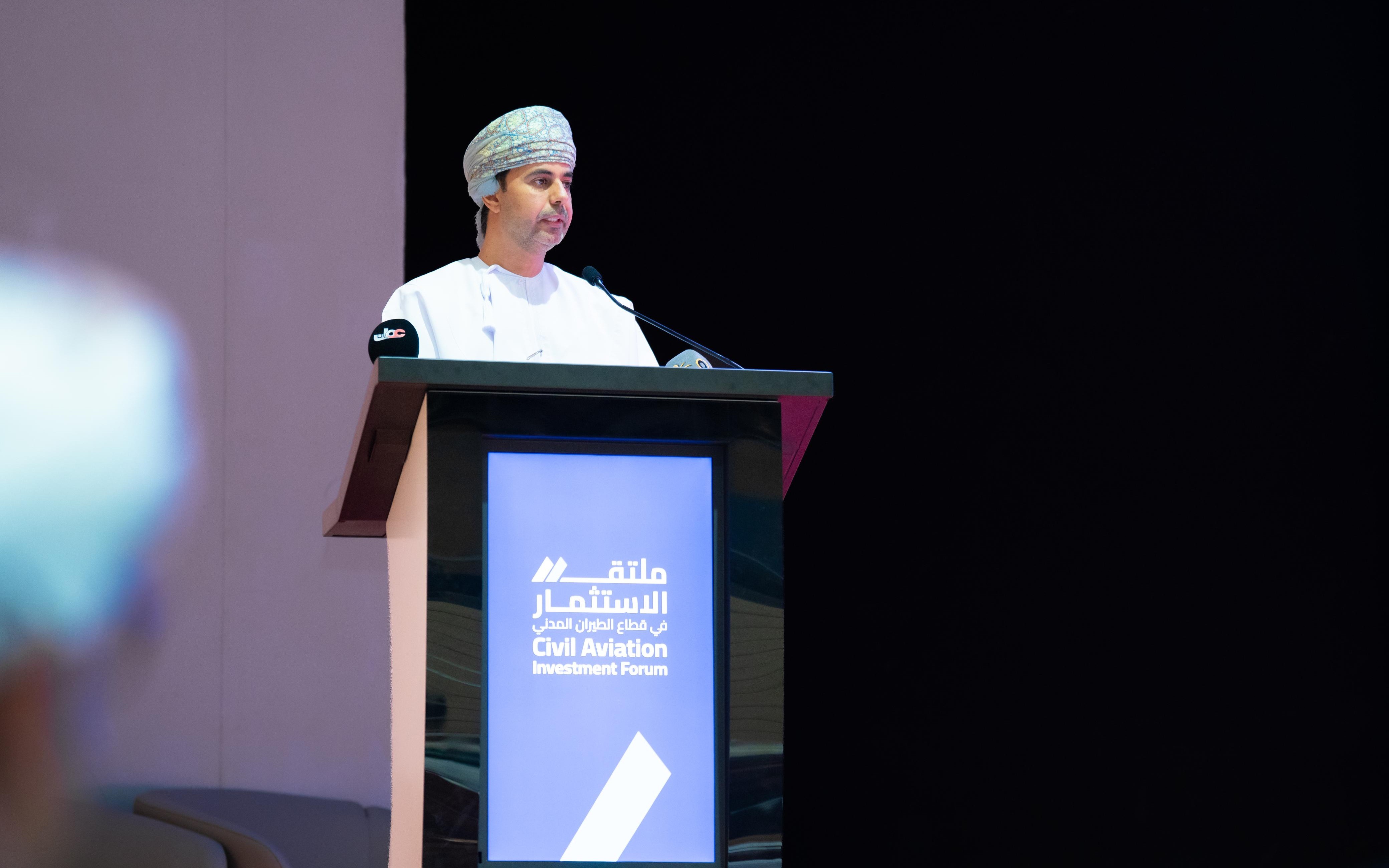
In his remarks at the opening of the forum, H.E. Eng. Naif bin Ali Al-Abri, President of the Civil Aviation Authority, emphasized that: “The aviation sector considered as one of the key drivers of national economic diversification, strengthening the role of the private sector, and attracting quality investments in support of the objectives of Oman Vision 2040.”
He added: “The aviation sector is a vital link connecting the Sultanate of Oman with global markets, supporting tourism, trade, and logistics services, and transforming its strategic geographical location into economic opportunities capable of sustainable growth.”
H.E. Al-Abri further clarified: “The Civil Aviation Authority has given early and clear attention to investment. This was reflected in the launch of the ‘Ethmar’ Strategic Program, which focuses on studying investment opportunities in the civil aviation sector and its assets. Following the launch of the program, a committee comprising a select group of specialists from government and private-sector institutions was formed. The committee worked to structure a number of investment opportunities in the sector, make them accessible to investors, and prepare them to move from concept to project. These responsibilities now fall under a specialized entity within the Authority’s organizational structure, namely the Investment Department.”
He pointed out that “The National Aviation Strategy 2040 has expanded this approach and placed it within a broader national framework. The economy was one of the nine strategic principles underpinning the formulation of the Strategy, based on the role played by the aviation sector in stimulating and diversifying the national economy and opening new avenues for investment, trade, tourism, and logistics services.”
In this context, he added: “The National Aviation Strategy 2040 represents a roadmap for transforming the sector’s potential into tangible economic value through the implementation of its 39 initiatives across three phases, with the first phase being established today. During this phase, we are laying the regulatory, investment, and institutional foundations upon which the sector’s growth in subsequent phases will be built. “
He noted that, “The Strategy places partnership with the private sector at the heart of its implementation model and has adopted the ‘Private Sector Attraction Program’ as one of its key enablers supporting the implementation of its initiatives. Through this program, we look forward to attracting cumulative private-sector investments of OMR 1.7 billion by 2040. This is an ambitious target; however, the promising opportunities we see and the interest we are witnessing from investors reinforce our confidence that, God willing, we will be able to achieve it ahead of schedule.”
He further added: “The aviation ecosystem is rich with broad and diverse opportunities, beginning with the development of airport cities and their transformation into integrated economic hubs, extending to the growth of air cargo and connecting the Sultanate of Oman to global supply chains, localizing value-added aircraft maintenance services, and investing in emerging technologies”
He pointed out: “At the forefront of these technologies is Advanced Air Mobility, for which we are working with our partners to establish the appropriate regulatory and investment environment. Accordingly, this forum is a continuation of a path initiated by the Authority years ago and represents a new step towards bridging the gap between opportunity and investment decision-makers. The forum also provides a direct platform for dialogue on available opportunities, the enablers required by investors, and the challenges that we need to address together.
”
H.E. concluded his remarks by saying: “We look forward to this forum to generate more mature investment opportunities and partnerships that move from the dialogue table to implementation on the ground, as well as establishing an ongoing channel of communication between the Authority, investors, and other sector partners. “
He added in his conclusion: “We also aspire for the forum to become an annual occasion through which we review what has been achieved, follow up on what we have initiated, and open new pathways for investment and growth. The future of aviation in the Sultanate of Oman is being shaped today through bold decisions, quality investment, and partnerships that bring together the ambition of the State and the expertise of the private sector.”
During the forum, a number of agreements and memoranda of understanding were signed, most notably a concession agreement between the Civil Aviation Authority and Indonesia-based GMF AeroAsia for the operation and management of the aircraft maintenance building and facilities at Muscat International Airport. This agreement grants the company a concession to operate and manage the building and aircraft maintenance facilities at the airport.
Another concession agreement was also signed between the Civil Aviation Authority and Oman Airports for the operation, management, and development of Muscat International Airport, Salalah Airport, and Sohar Airport, granting the company a concession to operate, manage, and develop the three airports.
Furthermore, a student training cooperation agreement was signed between Oman Aviation Academy and the Arab Aviation Academy to cooperate in the training of Oman Aviation Academy students.
Also, a memorandum of understanding was signed between GMF AeroAsia and MRO International to develop business in the fields of aircraft maintenance, wheels and brakes, and training, strengthening strategic cooperation between the two parties and supporting the development of these fields.
The forum includes presentations on operational and foreign investment opportunities across the Omani airport ecosystem, as well as investment models in emerging technologies and Advanced Air Mobility (AAM). It also highlights efforts to redesign and enhance the investor experience in the aviation sector, streamline procedures, and strengthen integration among relevant stakeholders.
The Aviation Investment Forum focuses on investment in human capital through showcasing models for training, qualification, and national capacity building in line with the sector’s future requirements and supporting the readiness of national competencies.
The forum concludes with a panel discussion entitled “Investment in the Civil Aviation Sector: Opportunities and Enablers,” which discusses the investor journey from identifying an opportunity through establishing and operating a project, as well as the role of capital, partnerships, and national competencies in enabling investment in the sector.
The session addresses several themes, including “From Opportunity to Operation – The Investor Journey,” “Capital and Partnership – Who Invests and How,” and “National Competencies as an Investment Enabler.” It also features a rapid-fire segment entitled “One Step Before 2030,” highlighting practical steps that can contribute to strengthening investment in the aviation sector.
It should be noted that the forum aims to attract new investments, raise awareness of investment opportunities, enhance the investor experience, strengthen integration among relevant stakeholders, and highlight investment in emerging technologies and human capital development, thereby enhancing the aviation sector’s contribution to economic diversification and supporting the objectives of the National Aviation Strategy 2040.
Source:
Civil Aviation Authority
5 October 2026